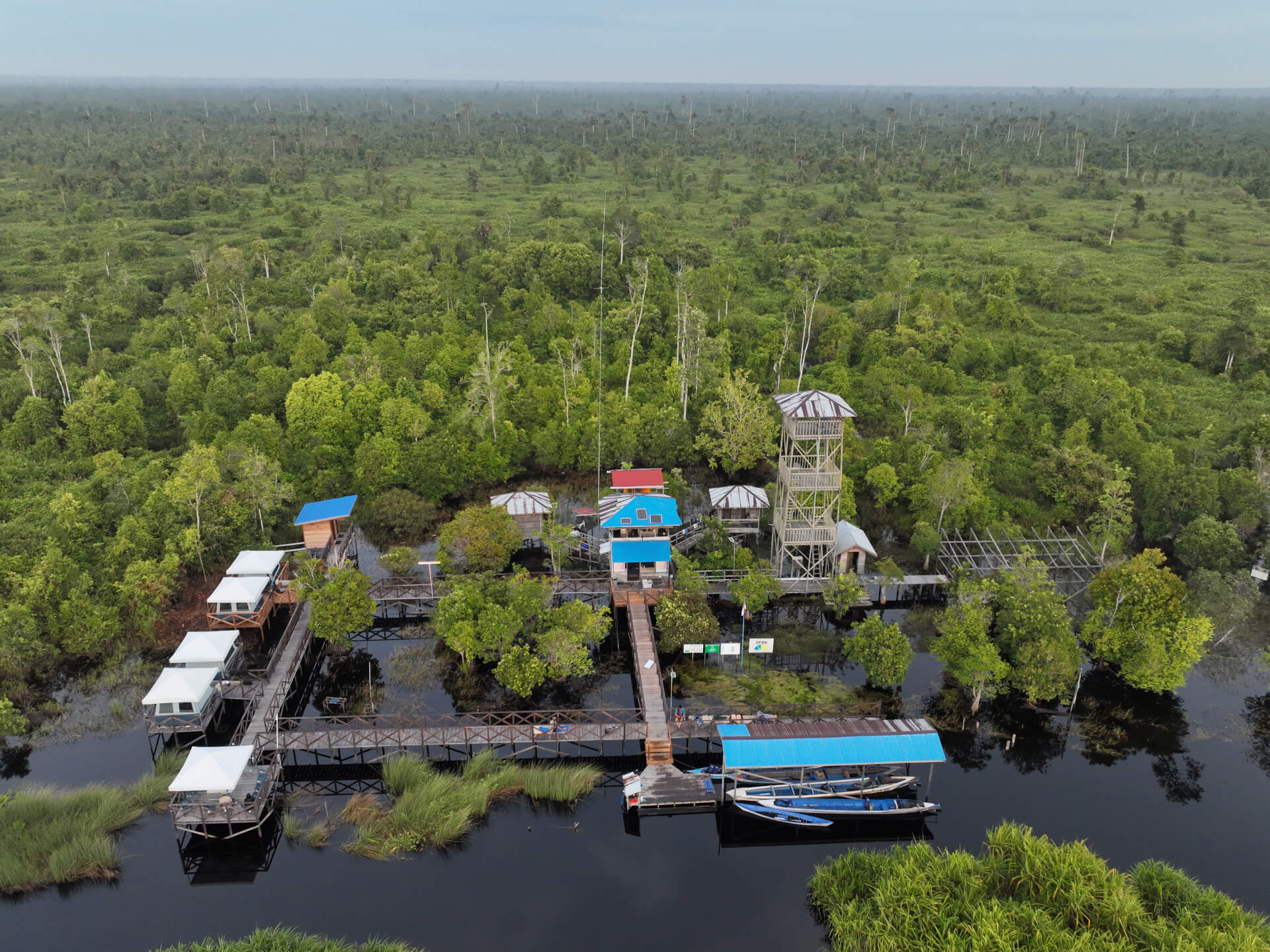


The Katingan Mentaya Project is a tropical peatland forest protection and restoration project in Central Kalimantan, Indonesia, operating since 2010 across the Mendawai, Kamipang, Seranau and Pulau Hanaut sub-districts.
Covering a combined area of 157,875 hectares, the project is operated by PT Rimba Makmur Utama (RMU) under a 60-year Ecosystem Restoration Concession (IUPHHK-RE), during which time it is forecast to prevent more than 400 million tonnes of CO₂-equivalent emissions. On 6 July 2026, following the reopening of Indonesia’s international voluntary carbon market, the project had 20 million credits verified by the standard body Verra.
With a new chapter opening in the story of Indonesian carbon finance, this is an opportune moment to revisit some important questions: how does the project work in practice? How does the project effectively measure and monitor its climate impact? And who are the people driving these impacts at ground level? In this article, we provide the answers.
How it Works: Conservation Through Carbon Finance
The project, which has received a AA rating from the carbon market’s two leading ratings agencies, is financed through the sale of verified carbon credits. Each unit represents one tonne of independently audited CO₂-equivalent emissions avoided through the protection of standing peatland forest. These credits are purchased by corporate buyers in the voluntary carbon market (VCM) and used, alongside the buyer's own decarbonisation efforts, to compensate for emissions the buyer has not yet been able to eliminate from their operations or value chain.
A credit does not undo the buyer's own emissions, nor does it give them permission to pollute; instead, climate finance is channelled into the continued protection of peatlands, partnerships with communities and the science, monitoring and fire-response infrastructure that makes protection possible.
Without that foundation of carbon finance, the project—and the climate action it represents—would not be able to exist and operate at this scale. Carbon credits are both the mechanism through which a buyer compensates for emissions and the system through which standing forest is given a real, financeable value.
Additionality: How the Project is Preventing Deforestation
Additionality is the term used to describe how an activity has prevented something negative that would have happened had no steps been taken. For a project that claims to protect a forest area, it must be able to show that had it not intervened, there was a high risk the deforestation and degradation would have occurred. The project demonstrates additionality through documented evidence that the project area was under genuine threat of industrial plantation conversion before it was protected. In 2007, the area was classified as Permanent Production Forest and identified by the Indonesian government as land available for industrial timber plantation development. In 2008, a plantation company, PT Kayu Alam Kencana, formally applied for a 50,000-hectare concession within what is now the project area. This provides direct evidence that commercial interest in converting the landscape was real and active.
The Katingan Mentaya Project’s baseline scenario is supported, not only by this documented application, but also by the broader regulatory and economic conditions at the time. Government policy actively encouraged the expansion of Indonesia’s pulpwood sector, while concession size limits meant that a landscape of nearly 150,000 hectares would likely have been developed by multiple operators rather than a single company. Comparable peatland landscapes across Indonesia show the same pattern of multi-operator plantation development, and adjacent concessions in Central Kalimantan were being established during the same period using similar infrastructure and business models.
The project’s avoided deforestation claims are further strengthened by independent verification. The project baseline has been developed and validated under the Verified Carbon Standard (VCS, VCS ID 1477) and has achieved Triple Gold certification under the Climate, Community and Biodiversity (CCB) standard. It has been independently rated AA by both BeZero Carbon and Sylvera, placing it consistently in the top 1% of nature-based projects globally. These assessments provide additional assurance that the project’s emissions reductions are real, additional and supported by robust evidence.
Community Support: Cornerstone of the Katingan Mentaya Project
The project is built on long-term partnerships with local communities. To date, RMU has signed more than 80 Memoranda of Understanding (MoUs) with 41 villages and sub-districts surrounding the project landscape, creating a formal framework for collaboration, benefit sharing and joint decision-making processes. These agreements are underpinned by a rigorous Free, Prior and Informed Consent (FPIC) process, extensive stakeholder engagement and participatory mapping exercises that ensure communities are fully involved in shaping activities within their customary landscapes.
At its core, the project seeks to demonstrate that forest protection and community development are two sides of the same carbon credit coin. The project has helped create more than 390 jobs between 2020 and 2023, with the majority of RMU’s workforce recruited from the region immediately surrounding the project. It also supports a wide range of locally driven programmes, including village fire brigades, microfinance initiatives, sustainable fisheries, education and healthcare services. Notable investments include a solar-powered electricity facility and advanced albumin production plant in Tampelas Village, a river-boat clinic that delivers medical services to remote communities, 55 health posts and 21 schools.
Crucially, the project does not take land away from communities or restrict legitimate customary rights to access, utilise and value natural heritage according to age-old traditions or the necessities of daily life. Instead, it works to strengthen local tenure and governance, recognising that secure rights are fundamental to both community wellbeing and the long-term viability of conservation outcomes.
Through its support for Indonesia’s social forestry programme, the project has helped 11 villages secure formal tenure rights over their forests, providing greater legal certainty and control over local resources. These achievements reflect a broader vision of a restorative economy; one that improves livelihoods, strengthens community resilience and creates lasting incentives to keep forests standing for future generations.
In Summary:
The Katingan Mentaya Project demonstrates that high-integrity carbon finance can deliver measurable climate, biodiversity and community outcomes at scale. The project protects 157,875 hectares of globally significant tropical peatland, is projected to prevent approximately 430 million tonnes of CO₂-equivalent emissions over its lifetime and operates under internationally recognised standards that have earned independent AA ratings. Its additionality is underlined by documented evidence of historical plantation interest and well-established deforestation pressures across the region.
Equally important, the project shows that lasting conservation depends on local partnerships. Through collaboration with communities, support for jobs, healthcare, education, sustainable livelihoods and land rights, the project has sought to align forest protection with local aspirations and equitable economic opportunity. The result is a model in which standing forests generate tangible value for the people who live alongside them, creating long-term incentives for stewardship rather than conversion.
Ultimately, the success of the Katingan Mentaya Project rests on a simple principle: forests are most likely to remain standing when protecting them delivers tangible benefits for both people and planet. By combining rigorous science, independent verification and community-led development, the project offers a practical example of how carbon finance can effectively safeguard some of the world's most important ecosystems, while supporting the communities that call them home.
Frequently Asked Questions:
What is the Katingan Mentaya Project?
The Katingan Mentaya Project is a tropical peatland forest protection and restoration project in Central Kalimantan, Indonesia. Covering 157,875 hectares, it works to prevent deforestation, reduce greenhouse gas emissions and support sustainable development across 41 partner villages.
How does the Katingan Mentaya Project prevent deforestation?
The project protects forests that were previously at risk of conversion to industrial plantations. The project funds forest protection, fire prevention, restoration and community programmes through the sale of independently verified carbon credits.
Why are peatland forests important for climate change?
Peatland forests store vast amounts of carbon accumulated over thousands of years. When cleared or drained, they release significant greenhouse gas emissions. Protecting peatlands is therefore proven to be one of the most effective nature-based solutions for climate mitigation.
What is additionality and why does it matter?
Additionality is the test of whether the emissions reductions a project claims would have occurred without the project in place. It is the foundational question for any buyer of forest carbon credits because, without robust evidence of additionality, they are not paying for anything new.
How is additionality demonstrated by the project?
The project’s additionality credentials are supported by documented evidence that parts of the project area were actively targeted for plantation development before protection measures were put in place. The project's baseline has been independently validated under the Verified Carbon Standard (VCS).
How much climate impact does the project deliver?
Over its 60-year crediting period, the Katingan Mentaya Project is projected to prevent over 400 million tonnes of CO₂-equivalent emissions (equivalent to burning roughly 1 billion barrels of oil) by protecting and restoring one of the world's largest intact tropical peatland landscapes.
Has the Katingan Mentaya Project been independently verified?
Yes. The project is validated and verified under Verra's Verified Carbon Standard (VCS), holds Triple Gold certification under the Climate, Community and Biodiversity (CCB) Standards, and has received AA ratings from both BeZero Carbon and Sylvera.
How does the Katingan Mentaya Project benefit local communities?
The project supports employment, healthcare, education, sustainable livelihoods, fire prevention and community infrastructure. Between 2020 and 2023, the project helped create more than 390 jobs, with additional support for 55 health posts and 21 schools.
Does the Katingan Mentaya Project take land away from local communities?
No. The project does not take ownership of community land or restrict legitimate customary use of natural resources. Instead, it works with communities through Free, Prior and Informed Consent (FPIC) processes and supports stronger local land tenure and governance.
What is FPIC and why is it important to the Katingan Mentaya Project?
Free, Prior and Informed Consent (FPIC) is a process that ensures communities are fully informed and voluntarily agree to project activities that may affect them. FPIC is the central pillar of the project’s approach to building community engagement.
How does the Katingan Mentaya Project support community land rights?
Through its support for Indonesia's social forestry programme, the project has helped 11 villages secure formal tenure rights over their forests, strengthening local governance and long-term stewardship of natural resources.
What is a high-integrity carbon project?
A high-integrity carbon project is one that demonstrates real, measurable and independently verified climate benefits, while also delivering positive outcomes for biodiversity and local communities. The Katingan Mentaya Project’s certifications, independent ratings and community partnerships are evidence of its commitment to meet these standards.
Buy carbon credits from Katingan
Climate change is a global challenge that requires global action. We can help you meet your commitments to deliver a brighter future.